

The change had already gone badly by the time we were called in. The decision had been taken, the announcement had gone out, and the reaction from staff was sharper than anyone expected — visible resistance, real frustration, and pointed criticism of how the whole process was handled. I’ve sat with more than one leadership team in exactly that position, asking, with genuine honesty, how they had so badly misjudged the way it would land.
It is rarely for want of caring. More often than not, part of the answer was sitting in their own systems all along. They simply hadn’t looked at it.
Plenty of the organisations we work with have been using Insights Discovery for years. Hundreds of profiles, sitting in inboxes and team folders, each one a small piece of a much larger picture — one that, taken together, says something rich about how the whole organisation tends to think, decide and respond under pressure. The picture has been there all along. It has just never been looked at as a whole.
Most organisations use Insights Discovery the way it is most often introduced: one person at a time, or one team at a time. Someone completes their evaluator, receives their profile, and learns about their own blend of the four colour energies — Cool Blue, Earth Green, Sunshine Yellow and Fiery Red. A team comes together, maps itself on the wheel, and has a far better conversation about why they sometimes rub each other up the wrong way.
That work is valuable, and it remains the heart of what we do. But it stops at the team boundary. What very few organisations do is step back and ask a bigger question: when you aggregate all of that individual data, anonymously and at scale, what does your organisation actually look like?
The answer is often surprising, and almost always useful.
What a whole-organisation view can tell you
We did exactly this recently with a large organisation whose senior leaders had asked us to pull together an anonymised picture of colour energy across the whole business. When we aggregated the data, a clear pattern emerged, shown in the chart below: Earth Green was the single largest dominant energy at just over 41%, followed by Cool Blue at around 28%, with Sunshine Yellow at roughly 19% and Fiery Red trailing at just under 11%.
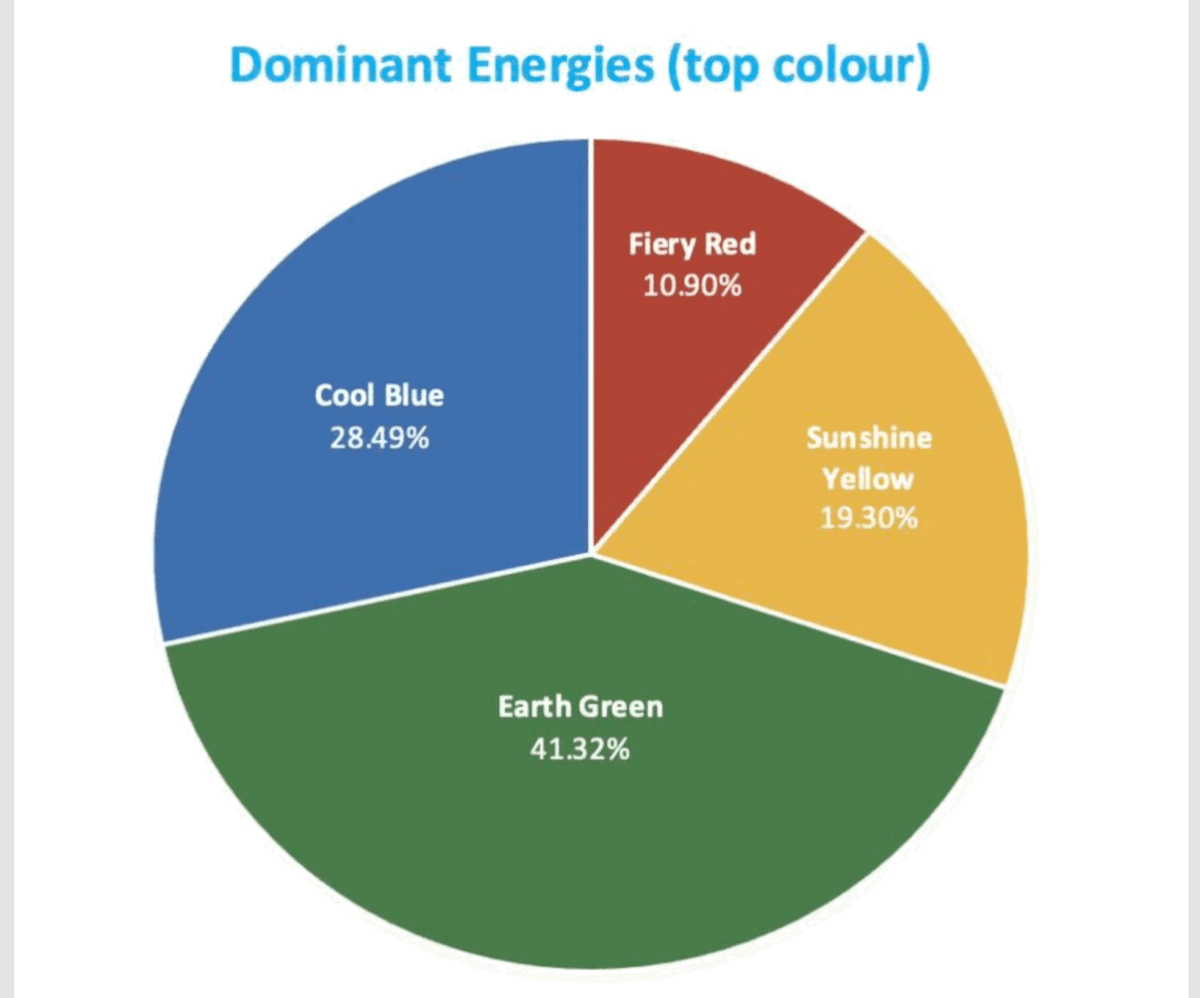
In plain terms, this was an organisation whose centre of gravity leaned firmly towards people who value harmony, consideration, accuracy and careful thought — with comparatively little of the fast-paced, direct, let’s-just-decide energy that Fiery Red brings.
That tells you something important the moment you have to communicate change. A predominantly Earth Green and Cool Blue organisation will receive a brisk, confident, light-on-detail message very differently from one that leans Fiery Red and Sunshine Yellow. What reads as decisive to one workforce can read as rushed, or even threatening, to another. For an organisation like this one, early, honest, specific communication — with time to absorb and respond — isn’t a nicety. It’s the difference between trust and anxiety.
And here is the part that tends to land hardest in the room: leadership teams very often share a behavioural signature that doesn’t match the wider workforce. If the people writing the change message skew more Fiery Red and Sunshine Yellow than the people receiving it, that mismatch stays invisible until you put the two pictures side by side. The collective data makes the gap visible.
The conversations it opens up
When we share a whole-organisation Insights picture with a leadership team, the discussion rarely stays on the chart for long. It moves quickly to questions that matter:
- How should we communicate change? If a large part of the workforce values security, detail and time to process, the tone, timing and level of detail in your messaging all need to flex to meet them where they are.
- Where are our blind spots? If a particular energy is barely present at senior level but common across the wider organisation, whose perspective might be routinely missing from the room when decisions are made?
- What does this mean for how we recruit and build teams? Not to hire for sameness, but to be deliberate about the balance a team needs — and to notice when a function has quietly become an echo chamber of one energy.
- How do we lead through uncertainty? When fear is in the air, people fall back on their preferences more strongly, not less. Knowing the organisation’s likely defaults helps leaders anticipate how stress will show up.
For universities navigating change in higher education right now — restructures, redundancies, budgets under real strain — these are not abstract questions. They are the daily texture of leadership. And the collective Insights view offers something rare in that context: a way to be more humane and more strategic at the same time.
A lens, not a label
A note of caution, because it matters. This kind of data is powerful precisely because it can be misused. Used well, it is a lens that helps leaders communicate with more care. Used badly, it becomes a set of labels that pigeonhole people and excuse lazy assumptions.
So the principles we work to are non-negotiable. The organisational picture is always anonymised and aggregated — it describes the whole, never the individual. People should understand how their data is being used and why. And the conversation it informs should always be about serving the workforce better, never about sorting people into boxes. At Agar Management Consultancy, we’d far rather a client used this insight to ask a better question than to reach a neater conclusion.
What you might do with this
If your organisation has been using Insights Discovery for any length of time, you are already sitting on something valuable. You don’t need a new initiative to make use of it; you need to look at what you have through a wider lens.
A simple place to start: before your next significant piece of internal communication, ask whether it has been written for the people receiving it, or for the people writing it. That single question — and the honest answer to it — is often where the most useful conversations begin.
So here is the question I’d put to any leadership team heading into change: have you looked at the people data you already hold — or only at the message you want to send?
And if you’ve used Insights at a whole-organisation level, I’d be interested to hear what it changed for you.